Public Assets is seeking:
Our next Executive Director
Please share
Please share
Vermont’s current education debate seems stuck on what to do first: Overhaul the governance structure and then reform the funding system, or do something about spending and then re-draw school district maps?
Governance should be the priority, but it’s not about the maps. The first question is whether Montpelier is going to take power from voters or local communities will retain the control they now have, but with better support from an Agency of Education adequately staffed and committed to assisting schools to improve education for Vermont children. Then people will know if they still have a role or decisions about funding and governance will be made for them.
Montpelier is fixated on per pupil spending and seems to believe an equation based on that single number tells us all we need to know to determine whether a school—or a state—is spending too much or too little. Per pupil spending is a useful metric. It’s helpful in assessing the fairness of the tax system and the distribution of education funds. But there are other metrics to consider—like student performance, community resources, and local needs—to understand how schools are doing and whether children are getting the resources they need.
Montpelier is considering two plans designed to control per pupil spending.
The short-term plan would cap the growth in per pupil spending for fiscal 2028 and 2029. The formula would be based on a district’s relative spending in the previous year. The lowest spenders could increase spending by around 8 percent, but many would be capped at 3 percent growth—less than inflation in recent years. If the proposed formula were in place for fiscal 2027, just over half of Vermont towns would be held to the 3 percent growth cap, based on their spending this year.
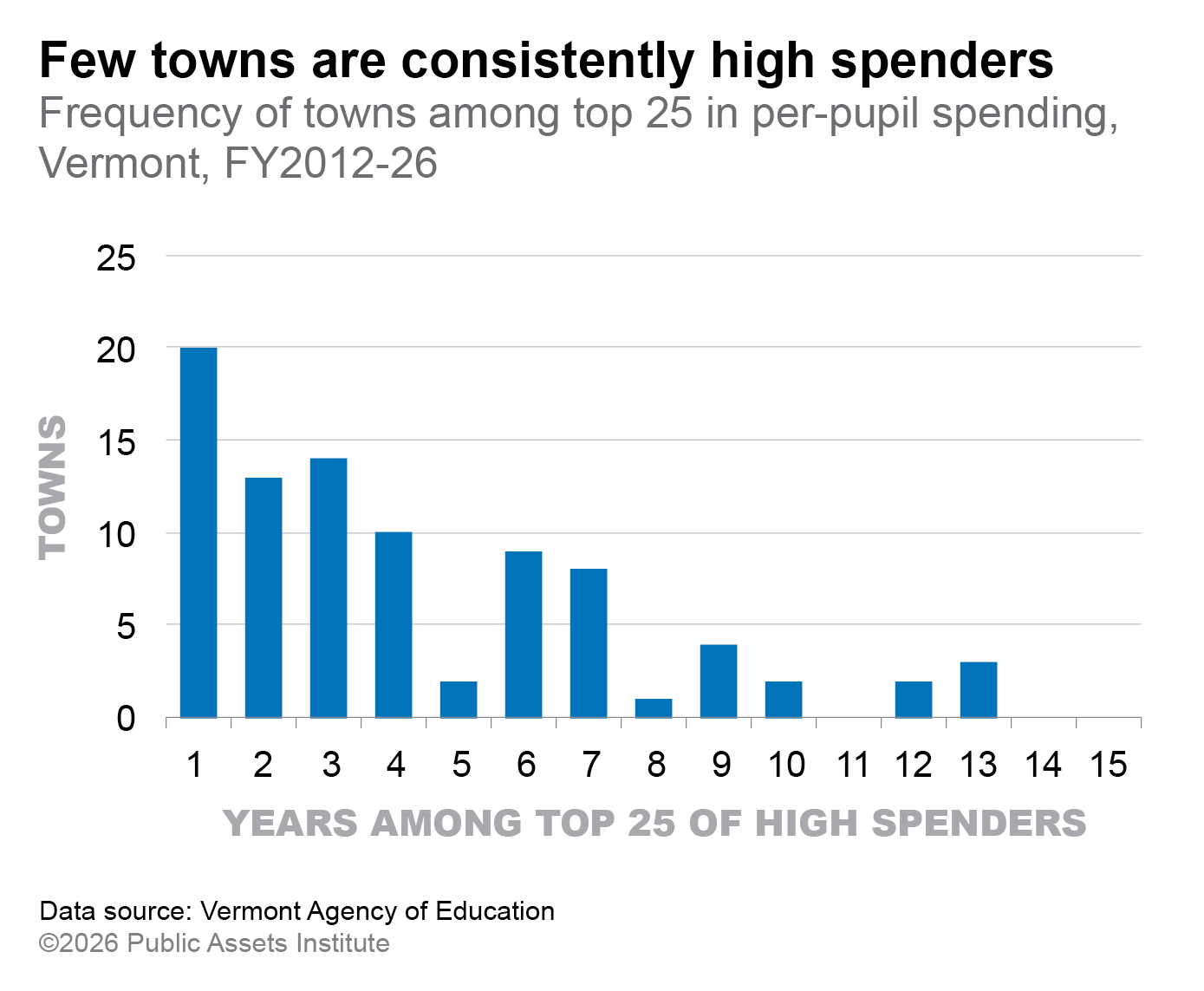 Vermont tried spending caps before. One problem with going after the high spenders is that few towns are consistently at the top of the list. For example, between fiscal 2012 and fiscal 2026, 88 different towns made the top 25 list. Fewer than half of those towns appeared on the list more than three times over those 15 years. And those towns account for fewer than 10 percent of Vermont students.
Caps punish towns that run into unanticipated costs, which underlines the broader problem of formulaic spending controls: they don’t look at why districts are spending money or what accounts for the differences between districts.
The proposed spending caps are meant to provide a transition to the long-term plan: foundation funding. This, too, would give Montpelier the power to curb spending by fixing per-pupil spending. Funding would vary for different categories of students, but would be the same district to district. The assumption here is that costs are evenly distributed across the state, that districts have more or less the same need for and access to facilities and services.
Vermont’s School Redistricting Task Force proposed a more nuanced and bottom-up approach to improving the education system. It uncovered important evidence that challenges a one-size-fits-all funding system. It provided examples where forces beyond school district control pushed up spending. It raised questions about Vermont’s ranking as a high-spending state by pointing out that not all states track “education” costs the same way. Again, the weakness of formulaic funding controls is that they don’t account for real-world differences between school districts, communities, and states.
The proposal recommended by the Task Force would empower local school officials, who have a better understanding of these real-world needs, to work collaboratively to share services.
This space isn’t adequate to summarize the 167-page proposal. But it deserves Vermonters’ full attention because it springs from a recognition of the value of local communities and public participation. In that way, the Task Force is coming at education reform from a very different direction: working cooperatively from the ground up. The governor and the Legislature, on the other hand, want to control the money.
So yes, the debate in Montpelier is about school governance and per pupil spending, but there is much more at stake.
