Education reform:
What changes under Act 73?
See the updates
See the updates
According to U.S. Census data, Vermont has been funding public education at about $50-60 for every $1000 of residents’ personal income for nearly 20 years. In fiscal 2009, the most recent data available, Vermont spent $1.4 billion, which worked out to about $57 per $1000 of personal income. As the chart below indicates, education spending relative to personal income rose following passage of Act 60 in the 1997, which it was expected to do, and has dropped in recent years. In fact, the ratio of Vermont’s education spending to personal income was higher in 1992 than in 2009.
So it’s odd that Campaign for Vermont Prosperity, a new organization seeking to promote public policy debate, has been running radio ads citing Vermont’s 2008 spending— $56 for every $1000 of personal income—as if it were news. 1
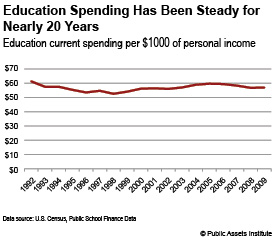 Although Campaign for Vermont Prosperity doesn’t say so explicitly, it seems we’re supposed to infer from the ads that Vermont’s relatively high ranking is a bad thing. The ads criticize Governor Shumlin and the Legislature for “refus[ing] to reform our statewide education funding system,” but don’t say how. It’s not clear whether Campaign for Vermont Prosperity believes we should be striving for higher test scores, even if it costs more, or that lower spending should be our goal, even if it means our kids have to settle for less of an education, closer to the U.S. average.
While the ratio of Vermont’s education spending to personal income has remained pretty constant for the last two decades, so has Vermont’s spending relative to the other states. In the 1990s, according to the Census data, Vermont usually ranked 3rd or 4th in education spending per $1000 of personal income. (It was 5th in 1996, just before passage of Act 60.) Since 2000—again according to the Census—it has ranked 2nd behind Alaska every year.
The recent evaluation of the state’s education funding system said Vermont has one of the most equitable funding systems in the country, thanks to Act 60 and Act 68. If other states were as equitable—that is, if there was less disparity in educational opportunity between their rich and poor communities—it is likely they would move ahead of Vermont in the spending-per-$1000-of-income ranking.
If Campaign for Vermont Prosperity wants to promote more public debate, its radio ads should be careful to accurately characterize the information it presents. The recent ads claim that Vermonters spend more of their income on education than residents of any other state. What the data show is the ratio of education spending to personal income. That doesn’t mean all of the money spent on education comes from Vermonters’ personal income. We know, for example, about 40 percent of the money in the Education Fund comes from corporations and from second homeowners who are not Vermont residents.
And perhaps Campaign for Vermont Prosperity could be clearer about defining the problem it sees and then suggest some solutions. If it really thinks we should back away from our commitment to education, Campaign for Vermont Prosperity should explain why educating our kids is no longer so important or why Vermonters have had their priorities wrong for the past 20 years.
