Education funding reforms:
the latest
the latest
The 2025-2026 legislative session was all about education reform. The governor began with a radical plan that called for forced consolidation and a shift of control over school spending from local communities to the state. While the Legislature did not agree with every aspect of the plan, it accepted the broad strokes, culminating in the passage of Act 73 in 2025.
Act 73 set up a framework for massive consolidation, which would then drive additional changes. It would double down on property value—rather than a hybrid of property and income—as the basis of school taxes. It would also return to a foundation system for school funding—where the state determines a uniform per-pupil spending amount—despite a prior version being deemed unconstitutional in 1997.
But the bill left a lot unsettled. The biggest issue was the establishment of consolidated districts. The Redistricting Task Force worked through the fall of 2025, but resistance from educators and community members along with a lack of evidence that mergers would lower costs, improve outcomes, or expand equity, moved it to recommend a voluntary approach to mergers.
The 2026 session ended without enough votes to pass any single consolidation plan, so lawmakers adopted a compromise. Act 170 required all districts to participate in merger committees starting in fall 2026, but the final decision will be up to voters on Town Meeting Day 2028.
As for funding, the Legislature awaits a report on what needs to be resolved to establish a foundation amount. Act 170 calls for more reports on the costs of pre-K programs, school construction, transportation, and tuition and fees. Questions on residential tax rates, second home taxes, and school construction remain unresolved.
Acts 73 and 170 aim to transform Vermont’s education governance, quality, and finance systems
see details in the downloadable PDF or in the drop downs below:
School/district consolidation |
||
| Current system | Enacted legislation in Act 73 of 2025 & Act 170 of 2026 | Updates |
| Vermont currently has 120 school districts and 52 supervisory unions. Local voters or school boards decide whether to close a school. | Act 73 established a School District Redistricting Task Force to propose three possible plans for districts of 4,000-8,000 kids.
With Act 170, the Legislature opted against forced consolidation, instead requiring all districts to participate in designated merger committees to explore the formation of unified, union school districts with at least 2,000 students. Merger committee recommendations are due on September 1, 2027, before public votes on whether to accept or reject merger recommendations on March 7, 2028. By November 1, 2029, the State Board of Education (BOE) must propose merger options for small districts that have not merged. |
What’s happened so far: The Act 73 School District Redistricting Task Force met from August to November of 2025. They opted not to recommend maps in their final report, but to endorse a longer-term, more cooperative approach for shared resources between schools and districts, which led to the voluntary merger committees of Act 170. What’s next: |
Cooperative Educational Service Areas (CESAs) |
||
| CESAs did not exist prior to Act 170; although cooperative structures were in place in some districts. | Following the School District Redistricting Task Force’s decision not to recommend new district maps, Act 170 created seven Cooperative Educational Service Areas (CESAs), tasked with delivering shared programs and services to save resources.
Act 170 assigned each Supervisory Union (SU) to a CESA, requiring each SU to appoint a board member to serve on its assigned CESA by July 18, 2026 and for the first meeting of each CESA to be called by August 2, 2026. |
What’s happened so far: CESA boards began meeting in the summer of 2026. What’s next: |
School Boards |
||
| Current system | Enacted legislation in Act 73 of 2025 & Act 170 of 2026 | Updates |
| Vermont currently has 900 school board members across 120 districts. | Act 73 aimed to reduce total districts with boards to 10-20 districts. Following the School District Redistricting Task Force’s recommendations that did not include new district boundaries, Act 170 did not create a forced merger process with an explicit number of school districts—so the eventual number of school boards is yet to be determined. | What’s happened so far: N/A—with the consolidation process shifting to merger committees, this work is on hold. What’s next: |
Statewide calendar |
||
| There is currently no statewide academic calendar. | Act 73 requires the AOE to establish a statewide academic calendar, to take effect in Academic Year 2028-2029. | What’s happened so far: N/A What’s next: |
Income sensitivity for property taxpayers |
||
| Current system | Enacted legislation in Act 73 of 2025 & Act 170 of 2026 | Updates |
| Vermonters currently have the option to pay income-based school taxes, provided as a credit against property taxes. For decades, two-thirds of primary homeowners have qualified. But fewer than half do now, due to failure to adjust for inflation and changing real estate values. | Act 73 returns education funding to a property tax-based system for all residential homeowners. Homestead exemptions will exclude a portion of primary home value from school property taxes for low- and moderate-income homeowners. However, property values will be the main driver of school taxes, leaving taxpayers vulnerable to volatility in property values.
Act 170 tasked the Tax Department with ensuring that homestead rates do not increase in the transition to the foundation formula and minimizing tax cliffs, along with recommendations for an inflation measure and expanding the exemption to households with incomes up to $175,000. |
What’s happened so far: Act 170 pushed back the implementation date for the homestead exemption by one year, from 2028 to July 1, 2029. What’s next: |
Foundation formula |
||
| Local school administrators and boards build budgets based on the needs of their kids with regular opportunities for community members to weigh in. Local voters then vote on those budgets, typically on Town Meeting Day.
Those voter decisions determine primary homeowners’ tax rates and the amount to be received from the state Education Fund. |
Acts 73 and 170 move the state away from local control over school budgets to a statewide “foundation formula”. The AOE and Legislature will calculate an annual foundation grant for a fixed funding amount per student, with supplemental funding for certain categories of students (rural, low-income, etc.). The Legislature will also set a uniform state property tax rate each year. Acts 73 and 170 commissioned several reports to guide the foundation formula implementation process. These reports include (1) a Foundation Formula Report, tasked with examining pupil weights, determining sparsity, providing career and technical education (CTE), and a recommended base grant amount (2) a School Transportation Report, tasked with reporting on the current landscape and cost of education transportation, as well as recommendations for education transportation under the new system (3) considerations on a funding mechanism for pre-kindergarten education and (4) a report on current tuitions and fees, with recommendations for the new system. The foundation formula is set to be implemented on July 1, 2029. |
What’s happened so far: While Acts 73 and 170 set up a framework for the foundation formula to be implemented, key details still must be worked out for the plan to move forward. What’s next: |
Property classifications |
||
| Current system | Enacted legislation in Act 73 of 2025 & Act 170 of 2026 | Updates |
| There are now two categories of property: homestead and non-homestead. Homestead property includes a primary residence and all contiguous land. Non-homestead includes everything else—commercial and industrial property, second homes, open land, etc. There is a uniform state tax rate on non-homestead property, while homestead rates vary town to town based on per-pupil spending.
|
Act 73 set up a framework to divide nonhomestead property into two categories: nonhomestead nonresidential and nonhomestead residential (targeted at second homes). This would allow the Legislature to set tax rates higher for second homes than for commercial, industrial, or other nonhomestead property. Act 170 further defined the nonhomestead residential property tax classification. The Legislature must choose to set new rates for the new property tax classification categories by the end of the 2029 Legislative Session, or the new categories are repealed. |
What’s happened so far: Act 73 commissioned a report from the Tax Department on the implementation of new property tax classifications, including definitions, forms, identification, and tax rate multipliers, submitted in December 2025. The legislature built on this work in the 2026 session to clarify the identification process for each property type, aiming to categorize second homes (nonhomestead residential) as year-round, habitable dwellings that are not used as primary residences or rented long-term. What’s next: |
State Aid for school construction |
||
|
There is currently no system for state aid for school construction, since the suspension of Vermont’s state aid for school construction program (created under Act 185 in 1996) in 2007. |
Act 73 set up a program, administered by AOE and an advisory board, to provide construction aid covering 20-40% of approved construction costs—though without determining a funding source.
Act 170 changed the program to cover at least 30% of approved funding costs. Applicants from consolidated districts and districts with at least 2,000 pupils are eligible for an additional 45% (75% total) of approved funding costs to be covered by the state. School construction expenditures are exempt from the cap on supplemental district spending. Under Act 170, AOE is required to begin including school construction funding requests as part of its budget submitted to the governor, but the program still lacks a clear funding source.
|
What’s happened so far: There have been previous task forces and working groups of school construction that informed the provisions in Act 73. While Act 170 moved away from forced district mergers, the law built in incentives for mergers in the state aid for school construction program. What’s next: |
Pupil weighting |
||
| Current system | Enacted legislation in Act 73 of 2025 & Act 170 of 2026 | Updates |
| Act 127 of 2022 established a new system of weighting students to provide supplemental funding for those deemed to need additional resources: children from families in poverty, English language learners (ELL), middle school and high school students, and students in small, rural schools. Act 127 additionally added categorical aid for schools with between 1 and 25 English language learners. These new weights took effect in the 2024-25 year. | Act 73 revised the newly adopted weights. It also removed the categorical aid for schools with between one and fifty ELL pupils, replacing that categorical aid and the ELL weight with tiered weights. It added new tiered weights for students with disabilities and replaced sparsity and small school weights with support grants for schools deemed small or sparse by necessity.
The new weights are set to go into effect with the new foundation formula and will be reviewed/updated every five years. |
What’s happened so far: N/A
What’s next: |
Special Education funding |
||
| Act 173 of 2018 changed special education funding to block grants based on total student population, which reduced funding for districts with a disproportionate share of special education students. This change took effect for the 2023-24 school year, so there is limited information about the impact. | Act 73 converts the block grant to new tiered weights for students with disabilities. AOE is tasked with reviewing and making recommendations for additional changes to special education funding.
Under Act 170, CESAs may pursue special education cost-sharing and service delivery. The adoption of the foundation formula is contingent on additional legislation to address special education. |
What’s happened so far: A report due from AOE on September 1, 2025 confirmed many past findings: increases in the number of kids needing services, increased external placements and other extraordinary costs, and a lack of evaluation of the effects of the last big reform, Act 173 of 2018.AOE was tasked with submitting a three-year strategic plan on special education by December 1, 2025. The report cited gaps in outcomes from students on IEPs and the need for additional oversight, but did not present a finalized strategic plan, instead creating the framework for a plan to be developed.For now, funding for special education is unchanged. What’s next: |
Regional Assessment Districts |
||
| Currently, individual municipalities are responsible for full reappraisals. | Act 73 created a framework for regional assessment districts, intending for all member towns to be reappraised every six years.
Under Act 170, these regional assessment districts are based on new district boundaries, following merger committee and voter decisions. |
What’s happened so far: Act 170 pushed back the implementation date from January 1, 2029 to January 1, 2031. Merger committees—which could affect the new district boundaries, and therefore regional assessment districts—have begun meeting. What’s next: |
Graduation requirements |
||
| Current system | Enacted legislation in Act 73 of 2025 & Act 170 of 2026 | Updates |
| Proficiency-based graduation requirements have been in place since 2014, beginning with the class of 2020.
Currently, each supervisory union or district sets its own standards, with districts requiring between 16.5-28.5 credits for graduation. |
Act 73 requires the State Board of Education (BOE) to recommend and establish new statewide graduation requirements.
The requirements are set to take effect in Academic Year 2027-28, first applied to the class of 2031. |
What’s happened so far: AOE was required to submit its recommendations for statewide graduation requirements by January 1, 2026. The requirements recommended a minimum of 22.5 credits to graduate. What’s next: |
Class size minimums |
||
| There are currently no class size minimums. | Act 73 created class size minimums based on average class size across service areas–not including certain types of classes, such as CTE and academic intervention. Waivers will be available for schools deemed “small by necessity” or “sparse by necessity”.
Schools that don’t meet minimums over three consecutive school years are held in violation of the minimums. The Secretary of Education may recommend remediation to the BOE for any school that does not meet minimums, which may include adjustments to supervisory union boundaries, school closure, district consolidation, or technical assistance. Average class size minimums are:
Multiage K-8 classrooms must be limited to two grades per classroom. |
What’s happened so far: Act 170 pushed back the enforcement date from Act 73’s original date. Class size minimums will begin to be enforced when the State Board updates the Education Quality Standards to reflect minimums or on July 1, 2027, whichever comes first. What’s next: The State Board of Education Class Size Minimum Subcommittee is expected to meet through the end of 2026, and is expected to commence rulemaking in early 2027.Since schools must be in violation of minimums for three consecutive years before AOE and State Board intervention, the first time the Secretary of Education may recommend remediation to any schools would be following the 2029-2030 Academic Year.In the meantime, the State Board of Education is required to update its rules to define “small by necessity” and “sparse by necessity” schools by March 31, 2027. |
The big news this year on education reform was public resistance to the governor’s insistence on forced mergers. It began with the recommendations of the School District Redistricting Task Force’s, which learned during hearings last fall that Vermonters just don’t want drastic, state-imposed consolidation. Despite the governor’s public pressure, including threats to hold the state budget hostage, the Legislature went along with a voluntary approach with Act 170, which the governor signed into law last week.
While the new law doesn’t make mergers themselves mandatory, it does require all school districts to participate in designated study committees to explore the formation of unified, union school districts with at least 2000 students. Merger committee progress reports are to be submitted to the Legislature by Feb. 1, 2027, and final reports and recommendations are due by Sept. 1, 2027. Voters will have their say on whether to accept or reject merger recommendation at Town Meeting 2028. Along the way, study committees have the option to dissolve if they conclude that merger is “inadvisable.”
The bill prohibits towns or groups of towns from leaving or dissolving union school districts until fiscal 2035.
The bill also shifts to a different model for shared services among districts, setting up seven Cooperative Educational Service Areas (CESAs) across the state. The CESAs will be staffed and required to offer special education services, business and administrative services, information technology, and to consult and facilitate in the creation of union school district. They can also offer additional services such as professional development and transportation if their member districts want them. Districts can opt into any of the services provided.
Like Act 73 last year, the legislation leaves important decisions to be determined later, including second home taxes, what would and would not be included in a potential foundation formula, and how to pay for school construction. The bill requires a number of reports before those decisions can be made. However, it calls for school construction “bonus incentives” that reward school districts for, among other things, mergers.
H. 949, the “Yield Bill,” establishes the school tax rates for fiscal 2027, and sets up some future changes for schools and taxpayers. The Legislature used a $100 million transfer from the General Fund and about $20 million in reserves to hold down property taxes for the coming year.
The average homestead property tax rate is expected to drop by 3.5 percent—to $1.54 from $1.59 in fiscal 2026. The average homestead income rate, for those who pay some or all of their school taxes based on income, is expected to decrease almost 1 percent. Despite the lower rates, because property values have risen, total homestead taxes for fiscal 2027 are forecast to increase by 4.6 percent. Still, thanks to extra General Fund money, the use of reserves, and lower-than-anticipated school budgets, the projected increase is less the administration’s forecast last December.
The “Yield Bill” also restore excess spending thresholds beginning in fiscal 2028. Districts incur tax penalties if their per pupil spending exceeds the spending thresholds.
Are Vermonters ready to take control of education spending away from local voters and cede it to the Agency of Education?
For hundreds of years, Vermonters have gotten together on Town Meeting Day to decide on how much they want to spend on their local schools. Are we ready to walk away from this connection to our schools? Both the governor’s and House’s plan would dismantle democratic participation in schools in two big ways:
Who should decide where and when to consolidate? How do we measure the value of a school to a community and how do you weigh that against any potential savings?
Vermont has a long history of educating our kids in local, community schools. State imposed consolidation:
Act 73 established a School District Redistricting Task Force to propose three possible plans for districts of 4000-8000 kids. The group met from August to November of 2025, but after hearing concern and resistance from many educators and community members, opted to respect the will of Vermonters and recommend a voluntary approach to mergers.
In Act 170, the Legislature passed a compromise approach, requiring all districts to participate in designated merger committees to explore the formation of unified, union school districts with at least 2,000 students. Those committee began meeting in the fall of 2026, and final reports and recommendations are due by Sept. 1, 2027. Voters will have their say on whether to accept or reject merger recommendation at Town Meeting 2028.
Act 170 also includes incentives for mergers and requires the State Board of Education to propose merger options for small districts that fail to merge by November 1, 2029.
For more information: https://vtruralschools.org
Are we ready to walk away from the 50 years of precedent that taxation for public education should be based on residents’ ability to pay and that a person’s income is the fairest measure of that ability?
 Since the 1970s, the state has been moving towards basing school taxes on income because the value of your primary residence is not a good measure of your ability to pay. For low- and middle-income Vermonters with mortgages, the value of the primary home overstates their ability to pay because their home equity is less than the home value. And many taxpayers have other debt so may even have a negative net worth. And at the high end, the primary residence is a small share of their wealth and understates their ability to pay.
 Because higher-income taxpayers are excluded under both the Governor and the House plans, it’s just redistributing the taxes among Vermonters under $115K or $125K in household income and creating different winners and losers. In aggregate, the group will bear a similar share of the taxes and continue to subsidize higher-income taxpayers.
House Ways & Means Committee Testimony—April 3, 2025: Homestead Exemption Increases Unfairness
In all of the education reforms of the last decade, we’ve heard that the way to improve schools is to spend less:
But we have not had good evaluation of any of those policies, in part because we haven’t really given them a chance to work before adding more changes into the mix. What limited information we have does not reflect much in the way of cost savings or improved outcomes. And now, after these major reforms of the last 10 years, we’re hearing again that a whole new system will save money and improve outcomes.
Act 46 of 2015
Act 46 of 2015 began a multi-year, multi-phase effort at school consolidation, with the goal of spending less but improving outcomes. While there has not been a comprehensive evaluation by the Agency of Education, other research has found limited costs savings or improvement in outcomes from the mergers and raised concerns about the effects of Act 46 mergers on communities.
Did Act 46 work? It’s complicated (Vermont Public)
Act 46: State Board of Education’s Final Report of Decisions and Order (Vermont Agency of Education)
MERGERS AND IMPOSITIONS: A CRITICAL LOOK AT VERMONT’S ACT 46 (Vermont Law Review)
Last Stand: Vermont School Districts Vow to Fight Forced Mergers (Seven Days)
Act 173 of 2018
Act 173 of 2018 changed how the state funds special education services, by converting a per-kid reimbursement system to district-based block grants. The promise was that it would save money while also providing schools with more flexibility in how they spent the money. But the block grants were calculated based on the total number of pupils in a district, not the kids that need these services. The result was that the majority of districts saw a decrease in funding and policymakers delayed the final implementation multiple times because of backlash from districts. Act 173 also required an evaluation of Vermont’s pupil weighting system, which led to Act 127 of 2022.
Vermont is changing how it funds special education. Some school districts say it’s not being done fairly. (VT Digger)
Lawmakers asked to delay special education reform law (VT Digger)
New Vermont special education law could affect local taxpayers (Vermont Journal)
Act 127 of 2022
Act 127 of 2022 changed Vermont’s pupil weighting structure, to be fully implemented by this year, fiscal 2025. Vermont has long counted pupils in different categories as more than one pupil because they need more resources, including those facing economic disadvantage, multi-lingual learners, and those at different grade levels. But Act 127 changed those weights and how they were calculated significantly, with the goal of making it easier for districts with more kids in these categories to spend more on education. But the implementation process had unintended consequences, contributing in part to the tax and spending increases in FY25. So the law has not really taken effect or been evaluated yet, even as the governor and Legislature propose an entirely new system for spending and weighting.
Vt. school superintendents appeal to lawmakers to change Act 127 (Times Argus)
‘Not intended as free money’: Lawmakers scold schools over spending (Vermont Public)
Act 127’s School Tax Impacts Appear To Be Greater Than Expected (The Bridge)
A Bill to Address Vermont’s School Finance Mess Advances, Despite Criticism (Seven Days)
There are two ways school taxes are unfair now:
The $47,000 threshold hasn’t been changed since 1985, and the $90,000 threshold has not beenupdated since 2008. And the property thresholds were actually lowered in 2018, because lawmakers wanted middle-income Vermonters to pay more even while allowing the highest-income Vermonters pay the least.
By giving higher-income Vermonters the property option, we’re letting the people with the most income off the hook on school taxes—they have 2/3 of the income in the state, but we allow them to pay school taxes based on property. We rely on low- and moderate-income Vermonters to subsidize their substantial tax break and leave billions of dollars of income untaxed.
Leaning into a property-based system through a homestead exemption approach won’t solve either of these problems.
SOLUTION: Update the income sensitivity thresholds immediately and then complete the move to income-based school taxes.
More:
How to make school taxes fairer this year and beyond
House Ways & Means Committee Testimony—January 29, 2025
Teacher health insurance, inflation, and rising demand for special education services and mental healthcare for kids are biggest cost drivers in school budgets and are outside of school districts’ control.
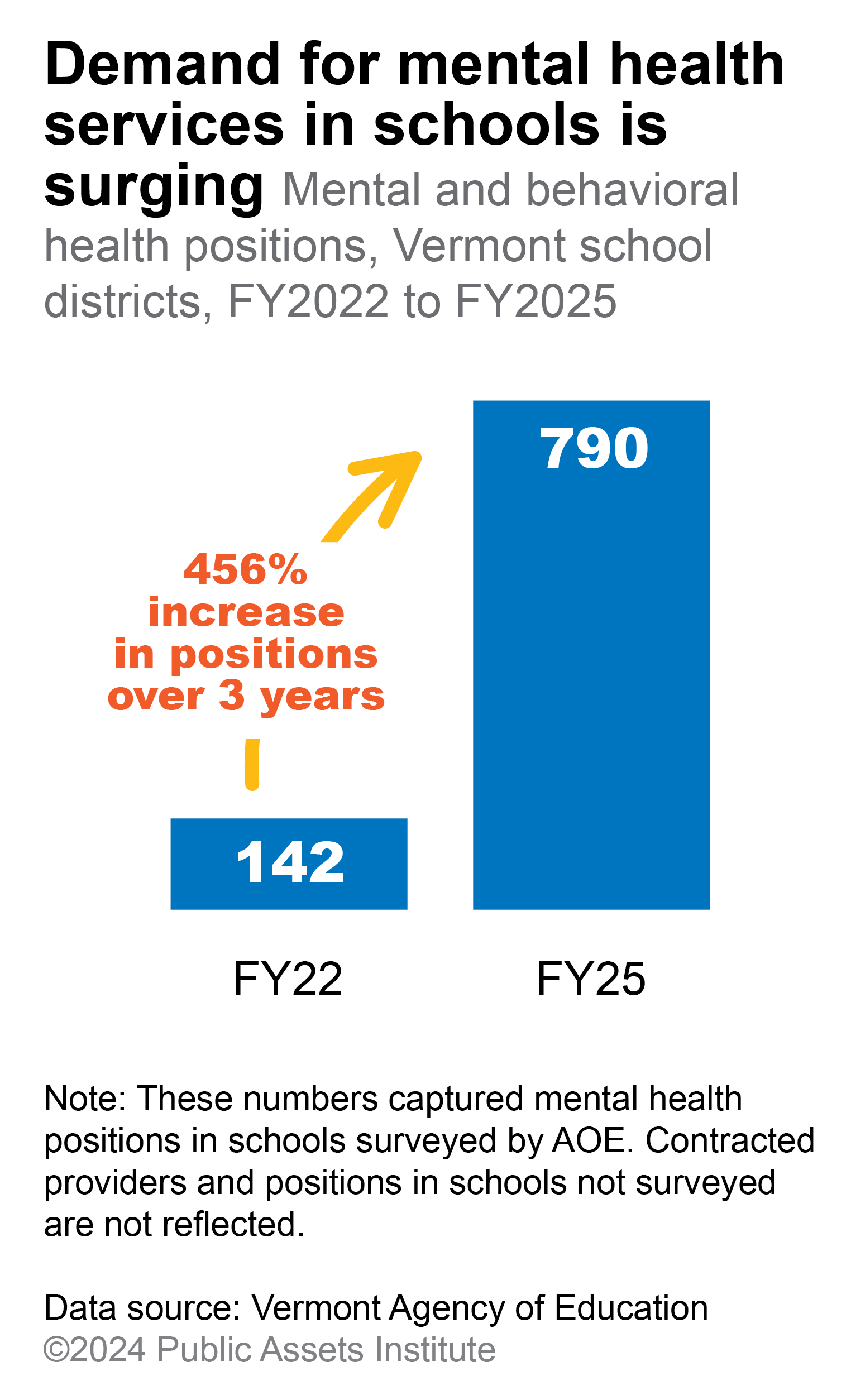 These aren’t school funding problems; they’re societal issues.
But they are squeezing our schools—and our kids—and putting some artificial statewide cap on how much schools can spend will only make things worse by forcing schools to cut essential programming in other places.
The state needs to get serious about reining in the cost of healthcare. Vermont has some of the highest healthcare costs in the country and until we solve that problem, school costs will continue to grow.
And we need to address our kids’ mental health needs. The demand for mental healthcare for kids and special education services has been growing for years. We need a robust system that doesn’t leave kids on waitlists for months or trapped in ERs for lack of mental health beds.
What’s more, these costs hit some districts much harder than others. In some parts of the state, there are lots of mental health providers and schools can contract with them to provide services to kids. But in more rural parts of the state, there are very few providers, so school districts might have to hire full-time mental health staff at a much higher cost to them. That’s not to say that we’re not all facing increasing pressure from the need for these services. But unless we address the root of these cost drivers, schools will still have to cover these uneven costs.
Spending cuts or a one-size-fits-all approach won’t make healthcare cheaper, increase access to mental health providers, or bring down inflation.
 Until the late 1990s Vermont schools were funded through a foundation system. The state determined a minimum amount necessary for an adequate education. If a town couldn’t raise that much on their own, the state would make up the difference. But state aid only got towns to “adequate” funding.
To spend more, they were on their own, which for poor towns meant much higher taxes for very little additional money per student. But for richer towns—towns with a ski resort or lots of other property wealth—a small bump in their tax rate would yield a lot more money to spend on their schools.
 The foundation amount essentially served as a floor for rich towns and a ceiling for poor towns. As a result, where a student lived had a really big impact on the resources available to them. And that’s still true in most states across the country, unfortunately.
And then in the mid-nineties, the Brigham family who lived in an under-resourced district sued the state under the common benefits clause of the Vermont constitution and won. The court’s decision emphasized the goal of protecting local control while pushing for greater equity across districts.
To keep a democracy competitive and thriving, students must be afforded equal access to all that our educational system has to offer.
– Vermont Supreme Court, Brigham Decision, February 5, 1997
 The subsequent changes to Vermont’s education funding system are grounded in three central principles: fairness for students, fairness for taxpayers, and protecting local control. Here’s what that means:
FAIRNESS FOR STUDENTS comes from the fact that school taxes are statewide taxes that go into one big pot that we all share—we are one of two states that have a statewide education tax (Hawaii is the other). That means in Vermont, school funding is not dependent on the wealth of the particular community.
 LOCAL CONTROL means that local school boards and local voters determine local spending and governance.
FAIRNESS FOR TAXPAYERS means:
Further reading:
Brigham Decision: Shared responsibility for funding education
20 years ago, Act 60 fundamentally changed the way Vermont pays for public education
Return to The Latest: Education Reform
Vermont has a unique education funding structure. And that can be both a blessing and a curse. It means that we have one of the most equitable systems in the country, where the wealth of the town does not determine how much schools are able to spend to educate the children in their community. Where the child lives matters much less here than it does in other states. We’ve succeeded in reducing the disparities in spending between rich and poor communities, where many other states are still struggling with that.
But the uniqueness also means that it can be hard for people to understand the system, especially when what they decide on their school budget doesn’t match what happens to their tax bill. And there are growing pockets of inequities that hit some taxpayers and some districts harder than others, meaning there’s plenty of areas where we can and should improve the system.
PROS – what is working well:
We strike a balance between state and local control: We pool resources statewide so that all kids have access to the same pot of resources, but local school boards and local voters set local budgets and manage their schools to reflect their local communities’ needs.CONS – the problems that remain to be solved:
 UNFAIRNESS IN WHO PAYS SCHOOL TAXES
THE BIGGEST COST DRIVERS ARE OUTSIDE OF SCHOOL DISTRICTS’ CONTROL
Quick reads:
20 years ago, Act 60 fundamentally changed the way Vermont pays for public education
How to make school taxes fairer this year and beyond
A fairer, simpler way to fund education
Education funding: The three cliffs problem
Education spending: What’s true
Citizen’s guides:
A Citizen’s Guide to School Funding: Vermont’s Act 68
A Citizen’s Guide to the CLA: Vermont’s Common Level of Appraisal Adjustment for School Taxes
o6/17/25: Yesterday, over the objections of educators, parents, students, and community members from across the state, the legislature passed the conference committee’s version of H. 454—a bill to make drastic changes in Vermont’s public education system.
The final conference committee report is now headed to the governor’s desk and we expect that he will sign it in the coming days.
The final version of the legislation prioritizes cost cutting over kids’ needs, is anti-democratic, does not address the cost-drivers squeezing so many school budgets, and fails to provide the timely tax relief that Vermonters asked for.
The bill leaves many significant details of these major changes to public education in Vermont unsettled. We’ll continue to update this site with more information about what’s in the bill, the timeline, the decisions still to be made, and more detailed analyses of the impacts.
o6/13/25: The Committee of Conference voted out a report Friday afternoon. An up-or-down vote on the bill in the full legislature is likely on Monday, June 16th.
Unfortunately, the committee’s report fails to fix the existing problems and raises significant additional concerns. The report:
o6/03/25: After meeting throughout last week, the conference committee on H. 454 failed to reach an agreement. The current plan is to keep working and come back in mid-June to finalize a plan.
The governor reiterated his priorities to the committee: cutting school funding; dramatic, rapid consolidation; centralizing control over schools in Montpelier; leaning into property taxes by eliminating income sensitivity; and the expansion of vouchers.
While some members of the committee resisted those funding cuts and voucher expansion, the group was largely aligned with the governor on the structural changes: eliminating local decision-making, significant but as-yet-undetermined consolidation, and moving away from a funding system based on ability to pay.
None of the plans have addressed the underlying cost drivers in school budgets or asked the highest-income taxpayers to pay as much as low- and middle-income Vermonters in school taxes.
05/27/25: The Senate passed their education reform plan Friday night, paving the way for a committee of conference to try to work out the differences between the two chambers this week. The Senate did go along with a lot of the big structural changes proposed by the governor and the House, including significant consolidation of districts, going back to a foundation system, and leaning into property taxes through a homestead exemption approach. The Senate follows a similar timeline to the House, rather than the accelerated version the governor has pushed. They differ from the House on how much to restrict vouchers and schools that qualify for public money, class size minimums and the size of consolidated districts, as well as some of the implementation and transition details.
05/23/25: As of 11:10 AM, the Senate may take up a different version of H.454 that is closer to the House-passed version, but there’s of lot of uncertainty and may be many floor amendments.
5/21/25: H. 454 is on hold in the Senate because its current version does not have the support of the majority.
5/19/25: H. 454 passed out of Senate Finance last week and will be on the Senate floor this week. The latest version goes along with a foundation system and a homestead exemption plan, but many questions about the details remain unanswered. The proposed foundation amount is higher than the governor’s plan but lower than the House amount.
05/13/25: The reform bill is not yet final and is now in Senate Finance. Based on the version from Senate Education and committee discussions, it’s looking like they’ll go along with some of the big structural changes in the House and governor’s plans. Those include moving to a foundation system and leaning into property taxes through a homestead exemption approach, but they’re looking at different numbers and possibly a different timeline. You can see our concerns about these changes here.
Like the governor and House’s plan, the current Senate plan does not fix the two most pressing problems we face in education funding: the fundamental unfairness in who pays and the cost drivers out of districts’ control.
And the Senate went along with the problems in the House’s yield bill for FY26. Both chambers agreed with the governor’s plan to give everyone a small tax break. This includes the richest taxpayers—who already get a big break—instead of targeted property tax relief for those who need it most. By using one-time money, the plan also creates a big hole for next year. And it doesn’t fix the income and property value cliffs that are harming low- and middle-income Vermonters.
